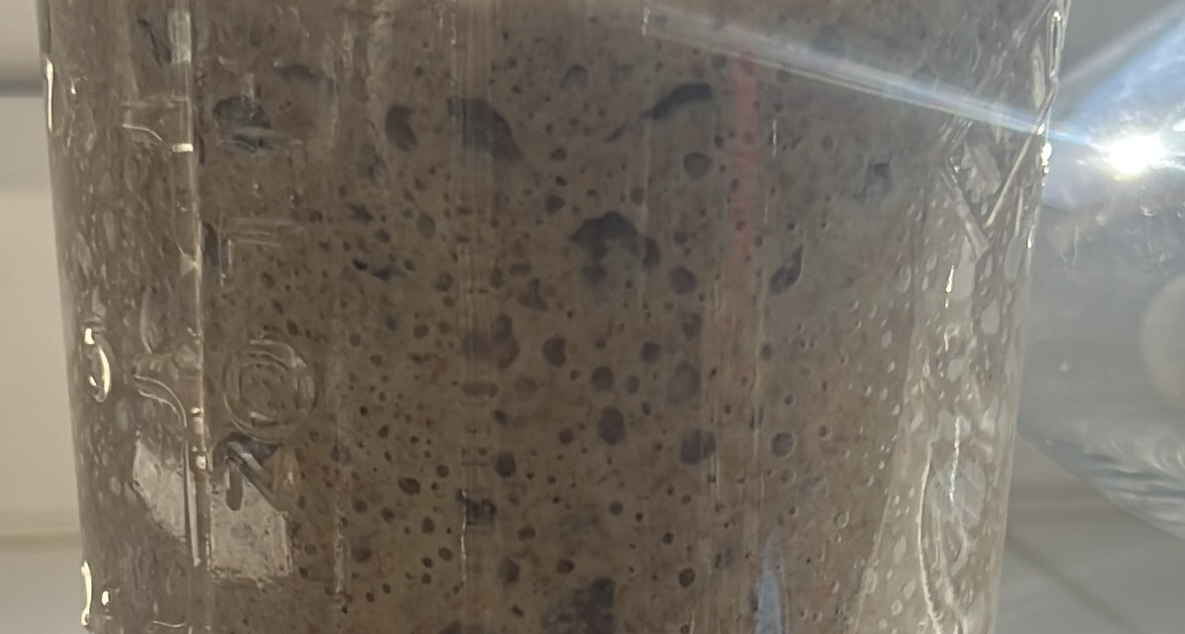
Yes, it's pretty foul to look at, and doesn't smell of roses. However, Starter is the key to the magic.
Feeding Quick Reference
1:1:1 - Starter:Water:Flour
For minimal bullsh#t, just start with an ingredient ratio of 1:1:1
50g starter with 50ml water, and 50g flour
This gives you 150g of starter.
If you use my bread recipes, you'll:
- put 100g in your dough,
- feed the rest knowing you've got 50g left.
Don't worry if you wobble a few grams either way - people were making this stuff centuries before kitchen scales were invented.
You can simplify it to "a spoonful of flour and a slop of water" and it'll still work.
Advanced tip: once you've got the hang of things, you can play with the ratios.
For oven-baked tradional sourdough, I like 1:3:2 (25g starter: 50g water: 75g flour).
Making your Sourdough Starter
To bake a sourdough, you'll need starter instead of the dried yeast you'd put in normal bread.
All we have to do is mix flour and water, and let it ferment to create a culture of wild yeast and good bacteria.
We can then throw that bubbly goop in with more flour and water to make bread.
It really is that easy.
Top tip
You can use plain flour, or bread flour, or you can get all artisan about it.
However, do not use: 00 grade pizza flour, self raising flour, bleached flour, or flour with any weird additives.
We want au naturel - full of the bacteria we need.
I personally use organic rye wholemeal flour, because I like the texture it gives the bread,
and it makes quite a bubbly starter.
Initial Ingredients
- 50ml water - slightly warm.
- 50g flour.
- A little bit of discipline.
Instructions
Day 1
Put the flour and water into a jar.
Mix it until it's a gloopy paste with no clumps of dry flour left.
Rest the lid on top of the jar (don't screw it on).
Go away. Come back tomorrow.
Day 2
First, throw away all but 50g. You heard me.
Now, stick in another 50g water and 50g flour and mix it.
Drop the lid on again (don't screw it on tightly - ever).
Go away. Come back tomorrow.
Day 3
Repeat Day 2.
Day 4
Repeat Day 2.
Day 5
Repeat Day 2.
By now it should be:
-
→ Smelling yeasty or fruity
→ Getting bubbly
→ Rising and falling slightly
If it isn't quite there, keep going for a few more days.
At some point between days 5 and 7 it should be ready. Look for:
-
✓ Doubling in size 4-8 hours after feeding
✓ Bubbling as it doubles in size
✓ Smells bready and a bit sour
At that point, we're ready to bake some bread.
Feeding your starter
When you've made your starter and you're in the swing of using it, you'll need to feed it periodically.
Generally, this will be 4-8 hours before you plan to bake anything.
- Throw away (discard) all but 50g.
- Add 50g water, and 50g flour.
- Mix. Lid. Leave it.
It'll reach a peak of rising, then start to deflate.
The peak is your optimum time to use it, but there is leeway, so don't worry if you missed it.
You're good as long as your starter is bubbly and active.
And at this point, you've got an active starter - a living culture of wild yeast and good bacteria.
Give it a name.
(Mine is called Bubbles).
More info: the BS, tips, and reassurance
So what have you just done?
You've taken some flour which naturally contains bacteria, and mixed it with water, then left it to ferment. It created yeast which will make your bread rise.
Why do we want our bread to rise? Well, if it doesn't, it's a pancake. I assume you're here because you want a loaf.
It takes a few days to get your starter going from scratch, but once it's bubbling, rising and deflating, you've pretty much nailed it.
When is it ready to use?
The water test: after day 5, when your starter is at peak bubbles and risen as high as it goes in the jar, just drop a teaspoonful of it into a glass of lukewarm water.
Did it float?
If it did, it's ready. If it didn't, it might need a few more days of feeding to get it going.
I still don't understand what feeding is
Yeah, I didn't either. Honestly, it's just a stupid name for topping up your starter mix, after you either use, or throw some out.
It's feeding because your mixture contains live bacteria and you are literally feeding them.
...well, you're feeding the ones left behind, because you've thrown the rest away as 'dicard', or baked them.
Why don't we screw the lid on
Because the bubbles contain gas, and if you seal the jar the pressure will build, and if you really mess up and have too much starter and gas it might explode. Only screw it on when you put it in fridge, and even then, not tight. You do not want an air seal.
On that note: the fridge?
Your starter will bubble and rise beautifully when it's warm, but maybe you don't want to bake every day, or even every week.
You can just store it in the fridge - the fermentation slows down - the colds puts the bacteria to sleep, and so it can stay in there for weeks or even months.
However, when it comes out, it won't really be usable at first. You'll have to restart the discard/feed cycle - it might take one feed before it's good to go, it might take a few before it's rising and falling as normal again.
If you leave it for too long, it'll also get a layer of dark, absolutely rancid smelling fluid forming over the top. This is called 'hooch' and it's basically moonshine. Don't drink it, ya filthy animal; just stir it in for tangy flavour or pour it off and down the sink.
Sometimes it rises fast after a feed and sometimes it's feeble. What did I do wrong?
Nothing. The bacteria in the starter likes warmth. In the summer mine is epic, but in the winter, it's slower and less fizzy. Sometimes I'll put mine in the utility room near the tumbledryer, if I want it to hurry up and bubble after a feed. Or on the counter over the dishwasher overnight. Gentle heat only - obviously don't microwave it or cook it. Direct sunlight has a pretty decent effect too.
What's going on with the 1:1:1 ratio and 50g/50g/50g amounts
Perspective is everything: it might seem like it generates rather a lot to discard, or it might seem like it's not enough to do anything.
That amount is simply what you need for the breadmaker sandwich sourdough loaf recipe on the Bread page.
It doesn't have to be 50g of everything, in fact for pizza you'll need to make a whole bunch more - but just remember the golden rule for easy, no-bullsh#t bread:
The simplest ratio of starter:water:flour is 1:1:1
Can I change the ratio?
Yep, you absolutely can. In fact, for traditional sourdough in a dutch oven, I prefer 1:3:2 (starter:water:flour).
What is that smell
Yes, the pungent smell is normal. Early on in the first days you might get a pukey smell too - also normal.
Eventually it's just pungent - you'll soon work out what passes for normal.
This seems like a lot of work
It's not. And don't think you have to be a slave to this - if you miss a day or two you won't kill anything.
You might kill it if you leave it for too long though.
If you let the starter go mouldy - specifically if you have nasty pink or orange crap - then you've screwed it, and it's poisonous.
Throw it away, wash the jar properly and start again.
Summarise what I'm doing from here onwards?
- Feed once daily or every other day if using regularly. Feed fortnightly if left in fridge.
- It's ready when it's doubled in size and gone bubbly - often that only takes 4–8 hours at room temp.
- It should smell tangy. Sharp, but not offensive.
- If it isn't playing ball, just keep on doing the discard/feed cycle til it recovers.